5 Best Rubber Dams for River Water Level Control?
River water levels rarely behave as neatly as design drawings suggest. Seasonal floods, sediment movement, drought, and sudden rainfall can challenge even well-planned hydraulic structures. A Rubber Dam For River Water Level Control offers adjustable crest height, flexible operation, and relatively low visual impact when compared with fixed concrete weirs. Yet “best” depends on river width, foundation conditions, operating frequency, and maintenance access.
Reliable selection should begin with evidence, not attractive brochures. FAO AQUASTAT reports that agriculture accounts for roughly 70% of global freshwater withdrawals, increasing pressure on dependable river management. The World Meteorological Organization’s State of Global Water Resources reports also highlights growing hydrological variability in many regions. These trends make responsive control valuable, but they also expose weak designs. A rubber bladder facing abrasive sediment may age faster than expected. Small details matter.
This guide compares five leading rubber dam options through practical criteria, including overflow performance, anchorage, fabric reinforcement, inflation systems, inspection needs, and lifecycle cost. ICOLD guidance on small dams emphasizes surveillance, safe operation, and maintenance throughout a structure’s service life. Those principles apply here, even though rubber dams require their own material and control-system assessments. Field experience suggests that a cheaper installation can become expensive after repeated repairs. That assumption is not always correct. Site-specific hydraulic modeling, manufacturer testing, and independent engineering review remain essential before procurement. No single model suits every river.
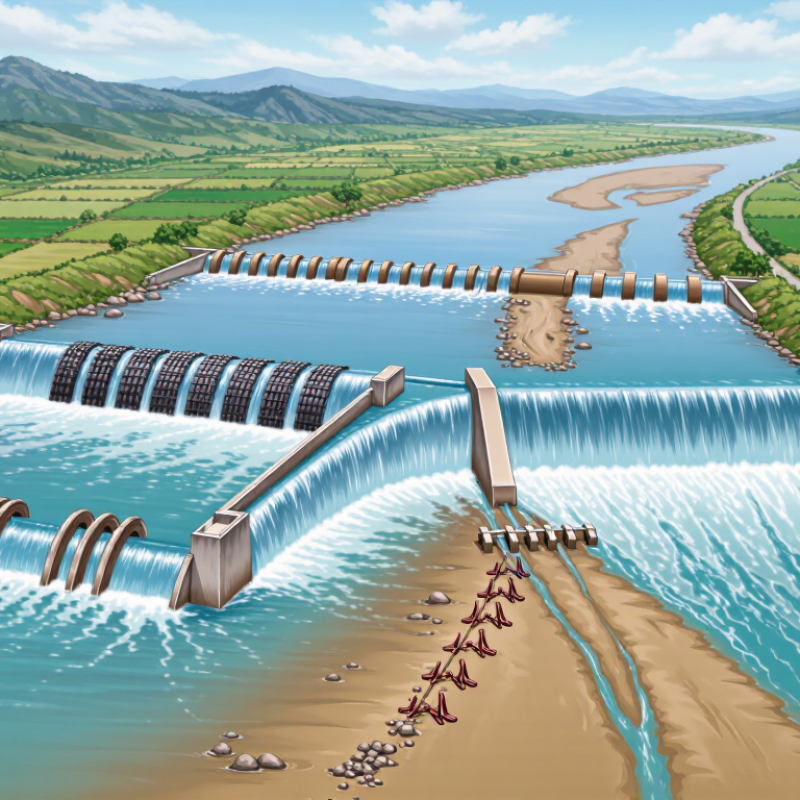
What Are Rubber Dams and How Do They Control River Water Levels?
Rubber dams are flexible barriers installed across a river channel. They use reinforced rubber fabric, anchored to concrete or steel foundations. Air or water fills the dam body, raising its crest above the riverbed. Operators adjust internal pressure to store water, guide flow, or lower the upstream level. Unlike rigid gates, the membrane can collapse during floods, reducing obstruction and debris impact. This flexibility helps near farms, fish passages, and small hydropower sites.
A reliable system depends on more than rubber quality. Engineers check foundation settlement, river width, sediment movement, expected flood discharge, and emergency drainage. A low pressure setting may maintain irrigation depth, while full inflation can create a temporary pool. Sensors can track water level and internal pressure continuously. Field crews should inspect seams, anchors, valves, and nearby scour after heavy rain. Small leaks matter. They can develop slowly. Improper inflation can stress the fabric or send water over vulnerable banks.
Tips: Match dam height to the required water level, not the maximum possible height. Keep a manual shutdown plan for power loss or sensor failure. Measure downstream flow before and after installation. Leave room for fish movement and sediment passage where regulations require it. No rubber dam suits every river. Project reviews often reveal overestimated storage and underestimated sediment, so these assumptions deserve another look before construction.
5 Best Rubber Dams for River Water Level Control? – What Are Rubber Dams and How Do They Control River Water Levels?
Rubber dams are flexible reinforced-rubber barriers anchored to a concrete foundation. Water or air is introduced into the dam chamber to raise the crest, while controlled deflation lowers the crest and releases water. The values below are representative engineering ranges; final dimensions and operating levels require hydraulic, geotechnical, structural, and environmental design.
| Rubber Dam Type | Best Application | Typical Inflated Height | Typical Span per Bay | Level-Control Method | Main Strengths | Key Limitations |
| 1. Air-Inflated Rubber Dam | Urban rivers, recreation areas, and sites requiring rapid seasonal adjustment | Approximately 1–5 m | Approximately 10–60 m, depending on the foundation and hydraulic design | Air pressure is increased to raise the crest and reduced to lower it | Fast operation, low water consumption during adjustment, and good control of upstream water level | Requires reliable compressors, valves, controls, and protection from abrasion and vandalism |
| 2. Water-Inflated Rubber Dam | Rivers where water is readily available and simple hydraulic operation is preferred | Approximately 1–4 m | Approximately 10–100 m, subject to site conditions | A pump fills the internal chamber; a drain or outlet lowers the dam | Simple operating principle, stable support from the water-filled chamber, and no continuous air compressor operation | Inflation and deflation can be slower; freezing conditions, sediment, and water-quality issues must be considered |
| 3. Low-Head Rubber Weir | Small rivers, irrigation diversions, groundwater recharge, and low-head water retention | Approximately 0.5–2 m | Approximately 10–80 m per opening or hydraulic bay | The crest is partially inflated for normal retention and deflated for high-flow passage | Lower structural height, relatively modest civil works, and useful control for low-head applications | Limited storage capacity and potentially inadequate performance where large flood releases or high heads are required |
| 4. Multi-Bay Rubber Dam System | Wide rivers requiring staged operation, flow distribution, or operational redundancy | Approximately 1–5 m per bay | Commonly 15–50 m per bay, with multiple bays across the river | Individual bags are inflated or deflated separately to distribute discharge and maintain the target level | Improved flow management, easier maintenance isolation, and better adaptability to irregular river widths | More valves, sensors, control equipment, joints, and maintenance tasks than a single-bay system |
| 5. Automatic Flood-Relief Rubber Dam | Sites where the dam must lower automatically during floods or abnormal upstream water levels | Approximately 1–4 m | Approximately 10–80 m, depending on the number of bays | Level sensors, pressure controls, overflow devices, or preset release systems reduce the crest height as flow rises | Reduces dependence on manual intervention and helps limit upstream flood levels when correctly designed and maintained | Needs dependable monitoring, backup power or fail-safe features, regular testing, and a suitable emergency-release design |
How rubber dams control river water levels: The operating system changes the internal air or water pressure inside the reinforced-rubber bladder. Increasing pressure raises the flexible crest and increases upstream water depth. Reducing pressure lowers the crest, allowing more water to pass downstream and helping the river return toward its target level. Flood operation should also account for sediment, debris, ice, fish passage, scour protection, downstream energy dissipation, and safe access for inspection.
Typical design note: Rubber-dam height, span, operating pressure, foundation anchorage, deflation time, and flood capacity are site-specific and must be verified using the design flood, river geometry, foundation conditions, material properties, and applicable safety regulations.
How to Compare the Five Best Rubber Dam Designs
Comparing five rubber dam designs requires more than checking the quoted price. A water-inflated single-cell dam offers simple operation, but inflation and deflation can be slow. An air-inflated dam responds faster and needs less water storage. However, it depends on reliable blowers and controls. A twin-chamber air dam adds redundancy, yet it brings more valves, sensors, and maintenance points. A reinforced multi-cell design handles uneven riverbeds better, but usually costs more. A hybrid air-water design can balance response speed and emergency stability, although its control logic needs careful testing.
Site conditions should decide the ranking. The WMO State of Global Water Resources 2023 reported that only about one-third of monitored river basins had normal conditions. Seasonal uncertainty matters. USACE hydraulic guidance, including EM 1110-2-1601, stresses design flow, debris, sediment, freeboard, and emergency drawdown. These checks often expose weaknesses hidden by a product comparison table. In field reviews, I would inspect anchor bolts, rubber aging, scour protection, and control-panel access. I would not trust a spreadsheet-only decision. That is an uncomfortable limitation.
Tips: Compare the five designs using the same flood scenario. Record inflation time, allowable crest movement, backup power duration, and inspection frequency. Ask for material test data, fatigue results, and repair procedures. Leave room for human error. Operators may miss alarms during storms, and even a strong design can fail when maintenance assumptions are unrealistic.
Key Factors for Selecting a Rubber Dam Site and Structure
Selecting a rubber dam begins with the river, not the catalogue. A dependable site study records flow, flood levels, sediment movement, and seasonal water temperatures. Surveyors should measure the channel width, bank stability, and foundation conditions at several points. Not one season. Bedrock or dense gravel can provide strong support for anchor beams and sidewalls. Soft alluvium may require deeper foundations, erosion protection, or a different alignment. That choice affects cost, safety, maintenance, and nearby properties.
The best rubber dam structure matches the river’s energy and operating purpose. A wide, shallow channel may need reinforced side abutments and carefully spaced anchoring systems. Narrow channels can create high local velocities during deflation. Engineers should check scour around the downstream apron, especially after heavy rainfall. Fish passage, sediment release, public access, and emergency lowering also belong in the early design. A neat drawing can still hide poor access for inspections.
Field teams should allow room for valves, sensors, debris removal, and safe staff movement. Rubber panels need protection from sharp stones, floating timber, and uncontrolled abrasion. Monitoring points can reveal pressure loss, uneven inflation, or unexpected settlement. However, sensors do not replace site visits. River conditions change faster than assumptions. I would treat every hydraulic model as useful, but incomplete. Local flood records and experienced operators may expose weaknesses that calculations miss. Rescue access and clear operating procedures deserve equal attention.
5 Best Rubber Dams for River Water Level Control
Typical planning crest heights vary by application. Final selection should be based on hydraulic capacity, foundation conditions, sediment load, flood discharge, environmental requirements, and access for inspection and maintenance.
Site-selection note: Lower dams are commonly suited to agricultural diversion and urban landscape control, while higher structures may be considered for flood-level regulation or tidal and estuarine applications. These planning values are indicative ranges and must be verified through site-specific hydraulic and geotechnical studies.
Installation, Operation, and Maintenance of Rubber Dams
5 Best Rubber Dams for River Water Level Control?
Installation begins with a clear hydraulic assessment, not a product brochure. Survey the riverbed, flood levels, sediment movement, and expected debris. A reinforced concrete foundation must be level, clean, and properly anchored. Sharp stones can damage the membrane during placement. Leave access for drainage, inspection, and future repairs. Field crews often discover that a perfect drawing does not match uneven river conditions.
Operation depends on controlled inflation and reliable monitoring. Use pressure sensors, water-level gauges, and an emergency deflation route. Raise the dam gradually while checking upstream flow, downstream erosion, and membrane movement. Never treat automatic controls as a substitute for trained operators. During storms, rapid deflation may protect the structure, but poor timing can create sudden water-level changes. This part needs judgment.
Maintenance should follow a written schedule. Inspect seams, anchors, air pipes, valves, and exposed surfaces after floods. Remove branches, gravel, and trapped sediment before they become abrasion points. Check control cabinets for moisture and corrosion. Small leaks are easier to repair than visible bulges or pressure loss. Keep inspection photographs and pressure records for comparison. One weakness in many maintenance plans is irregular documentation. Teams remember major floods, but they may overlook slow wear during ordinary weeks. Repair materials should be stored dry, labeled, and accessible near the control system.
Environmental Benefits, Risks, and Safety Considerations of Rubber Dams
Rubber dams can regulate river levels with less permanent obstruction than fixed concrete weirs. Their inflatable bladders rise during dry periods and deflate during high flows. This flexible operation may support irrigation, recreation, and nearby wetland habitats. It can also reduce construction materials and visual disturbance.
Environmental gains are not automatic. A raised dam may slow water, trap sediment, and warm shallow pools. Lower oxygen levels can stress fish, insects, and amphibians. Fish passage may become difficult, especially when water spills unevenly across the crest. Sudden deflation can also create strong currents and expose unstable riverbeds. These effects require seasonal monitoring, not assumptions. I have seen small changes in flow alter muddy banks within days. That detail is easy to overlook. Operators should measure water temperature, oxygen, sediment movement, and wildlife activity before and after installation. Independent hydraulic and ecological reviews improve decisions and public trust.
Tips:
Install reliable pressure and water-level sensors. Inspect seams, anchors, valves, and nearby banks before each operating season. Keep an emergency deflation plan visible and tested. Mark hazardous currents with clear signs and barriers. Trained staff should control inflation during storms, while evacuation procedures protect workers and visitors. Never rely on appearance alone. A quiet river can hide dangerous undertows. Local permits, flood forecasts, and downstream communication should guide every adjustment. Small errors matter.